
Disc Seeding in Modern Zero-Till: Why More Growers Are Making the Shift — And What Seeder They Did It With
Disc seeding has become a central part of many Australian zero-till programs. However, discs still divide opinion in some parts of the country. Even so, operators who persist with them point to real gains in sowing speed, residue flow, and seed placement accuracy. In particular, those gains matter when seasons deliver narrow planting windows.
At the same time, the cost of moving into disc seeding can be a major barrier. Therefore, RYAN NT builds affordable retrofit disc options to make disc seeding more accessible. In other words, we give growers a practical path into discs using the bars they already own, rather than requiring a full premium disc machine.
Importantly, we don’t only focus on first-time conversions. In fact, we also manufacture parts that lift the performance of many well-known disc seeder brands already working in the field. For example, we build our coil gauge wheels and closing wheels to solve common frustrations in conventional systems—especially rubber setups that wear quickly in abrasive soils and cake with mud during damp sowing windows. As a result, growers can protect lifting depth and improve furrow closure. Consequently, whether you’re stepping into discs for the first time or chasing more consistency from your current bar, you’ll find upgrade pathways that don’t require replacing the whole seeder.
A Review Of The Disc Seeding Machines We Can Fit
Finally, to keep this guide grounded in real paddock experience, we draw on Kondinin Group’s 2016 independent review of disc seeders that our gear can fit. Specifically, that review forms the backbone for the comparisons below. As a result, we’ve summarised the machine specs and operator feedback to make the takeaways practical.
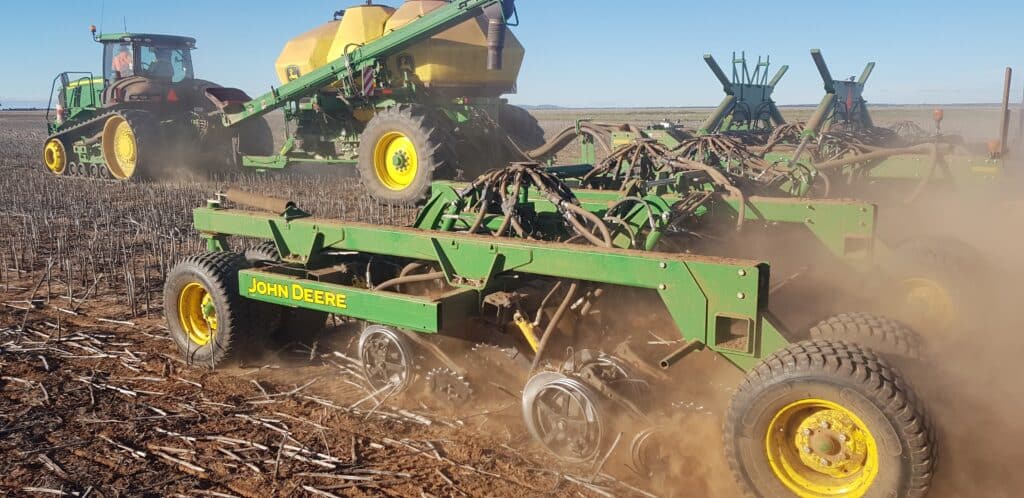
A New Disc Seeding Approach to Zero-Till Performance
In high-residue, controlled-traffic systems, discs shine because they cut stubble cleanly while barely moving soil. That low disturbance helps conserve moisture, protect structure, and reduce weed flushes, all while letting growers cover more hectares. Modern GPS autosteer has pushed performance further: inter-row sowing keeps openers between last year’s rows. This reduces stubble drag, lowering hair-pinning risk, and improving furrow closure.
Disc Seeding Challenges: Moisture, Residue, and Crop Establishment
Disc machines have clear limits, so growers need to manage them:
- Wet conditions: sticky clays and damp surfaces can coat discs, boots, and gauge wheels, upsetting depth control or stalling units.
- Residue handling: discs usually cope with heavy stubble. But matted trash or poor residue spread can resist penetration and disrupt seed placement.
- Pre-emergent herbicides: minimal soil throw means less incorporation than tines, so spray strategy often needs adjusting.
Success Depends on Operator Mindset when Disc Seeding
Across regions, the best results come from hands-on management: checking furrows, fine-tuning settings, and responding to humidity and moisture shifts. Preventative off-season maintenance matters too, because discs carry more moving parts, so bearings, boots, and blades need closer attention.
Below, we break down several of the most common disc seeder brands in Australia—based on the Kondinin review—and highlight the platforms you can fit with RYAN NT retrofit or performance-upgrade components.
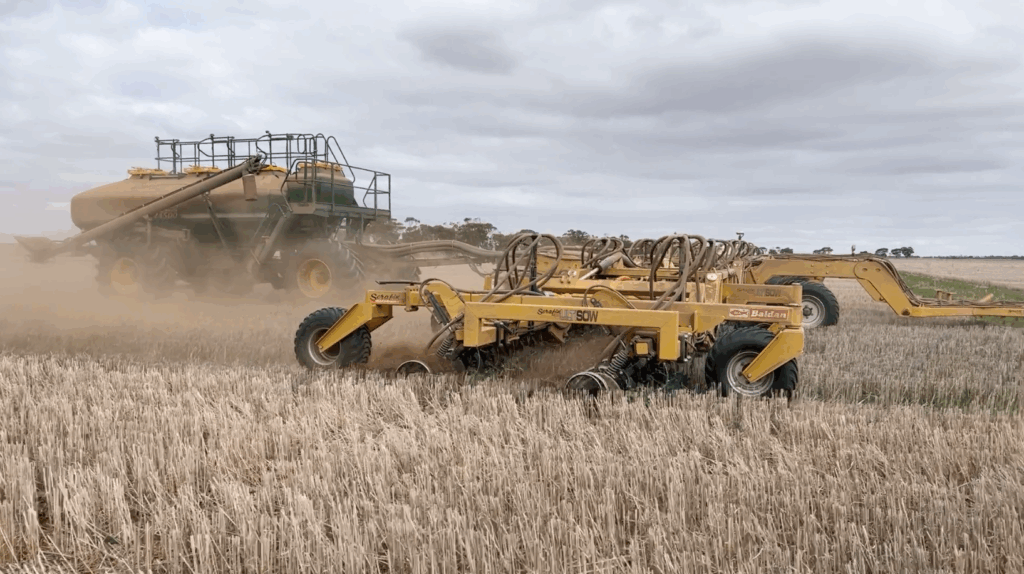
Boss Engineering SX25P: A Modern Single-Disc Built for Disc Seeding when Winter Cropping
Boss Engineering, from Inverell, NSW, is a newer player in disc seeding but has quickly built a solid footprint. After starting in tined gear, the company expanded into single- and double-disc systems plus air carts. For winter cropping, the SX25 and SX25P single-disc openers are their most common fitment. Growers value these units for their straightforward layout and broad retrofit compatibility. Boss starts row spacings around 375mm, and buyers can build complete machines out to roughly 24m working width.
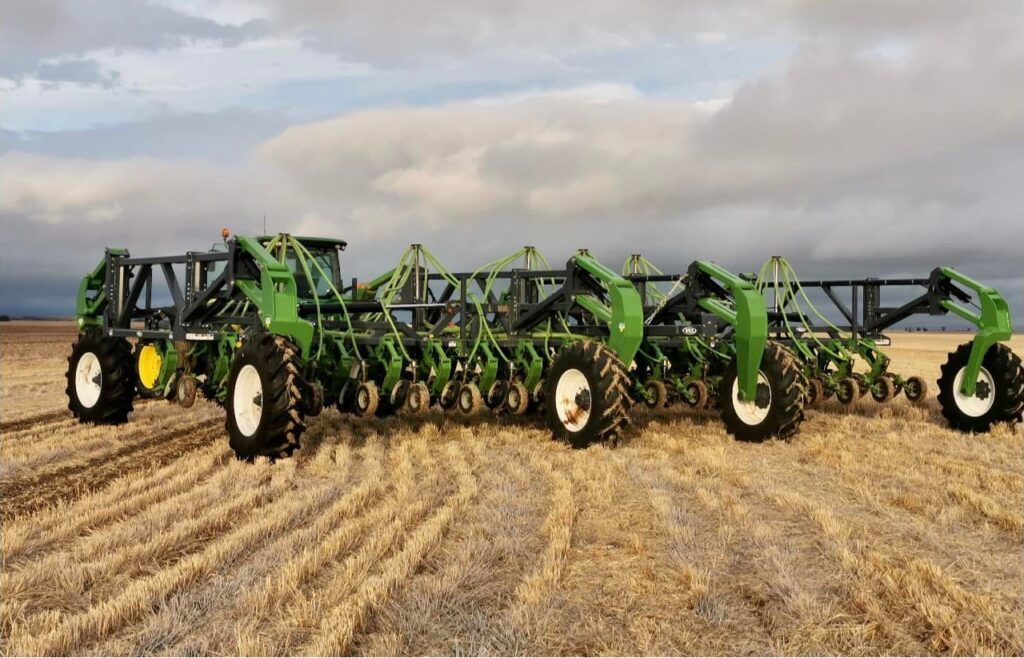
Image credit: Boss Agriculture, “For sale (sold) 12m Bridge Frame with SX25P units” Facebook post (2022).
Disc Seeding Design Overview: Simple, Strong, Retrofit-Friendly
The SX25P centres on a 460mm disc with a side-cleaning wheel. It has a trailing press wheel that also serves as the depth gauge. Buyers can choose among three opener styles: non-parallelogram spring, non-parallelogram hydraulic, or spring parallelogram. Depending on configuration, each opener weighs about 80–100kg. Much like the RYAN NT Disc system, Boss designed these units to bolt onto many existing bars, including older Flexi-Coil frames.
Residue Handling when Disc Seeding and Disc Geometry
The disc’s “undercut” geometry drives a lot of its performance: about 21° of top-to-bottom tilt and 7° of front-to-back tilt. This angle combination helps the disc penetrate firm soils and slice residue cleanly rather than push it. It also keeps horsepower demand reasonable. Growers interviewed for the review reported that this setup maintained smooth trash flow even in heavy stubble situations.
Maintenance and Depth Control when Disc Seeding
Servicing is basic and fast. Each row unit uses one grease point for the disc hub bearing. Operators typically grease the units every 12 hours, depending on soil type. The spoked cleaning wheel sheds mud and includes a stainless scraper ring to keep the disc face clean. Operators adjust depth through the press wheel arm, which locks into a saw-tooth adjustment track.
Indicative pricing (inc GST) as of 2016
At the time of the review, opener pricing sat roughly between $2,500 and $3,000. Overall an 18m bar on 300mm spacings priced around $313,500.
Operator Snapshot: Ruwoldt Family, Kewell, VIC
Justin Ruwoldt runs two 18.3m Boss single-disc seeders on 380mm spacing in a long-term controlled-traffic, zero-till program. Typical sowing speed is about 10km/h, fuel use is around 1.5–1.8 L/ha, and daily maintenance takes 15–20 minutes. His takeaway: the SX25P is simple and effective, but like all discs, it rewards regular checks and minor in-paddock adjustments to keep seed placement right.
Operator Feedback in Detail
| Operator: | Ruwoldt family, Glenvale Farms |
|---|---|
| Location: | Kewell, VIC |
| Operation size: | Large-scale |
| Crops: | Wheat, barley, canola, durum wheat and lentils |
| Annual Rainfall: | 380mm |
| Soil types | Soils at Glenvale Farms vary from black clays to red loams and in wet sowing conditions, can be quite sticky. |
| Disc seeder Brand | Boss |
| Disc seeder model | SX25P |
| Machine Width: | 18.3m |
| Seeder Weight | 15.5 tonnes |
| Row Spacings | 380mm |
| Sowing speed | 10km/h |
| Fuel Economy | 1.5 litres to 1.8 litres per hectare |
| Target sowing depth | Target sowing depth varies from 25-35mm. |
| Maintenance time | 15-20 minutes per day |
| Number of seeders: | 2 seeders |
| Tractor | 276kW John Deere |
| Controlled traffic Yes/No | Yes |
| Indicative Pricing 2016 (inc gst) | 18m seeder, 300mm spacing: $313,500 |
| Final Remarks | The Ruwoldts say the SX25P is a simple, reliable single-disc unit that delivers strong sowing efficiency and placement when set correctly. Their main point is that performance depends on regular in-paddock adjustment and close monitoring to keep seed depth and furrow finish consistent as conditions change. Quite a simple design but in the paddock, as with any seeder, there are adjustments to be made to ensure seed placement is as good as possible. |
Austil MT3500 / MT3510: Single-Disc Units for Hard Disc Seeding Conditions
Simplicity now builds Austil machines near Dalby in Queensland. The machine has earned a reputation for producing rugged single-disc openers aimed at reliable zero-till performance across broadacre hectares. The MT3500 and MT3510 (now the Simplicity SD-400) share the same core platform, with the main difference being how they apply pressure to the ground: the MT3500 uses spring downforce, while the MT3510 upgrades to hydraulic downforce for more in-cab control.
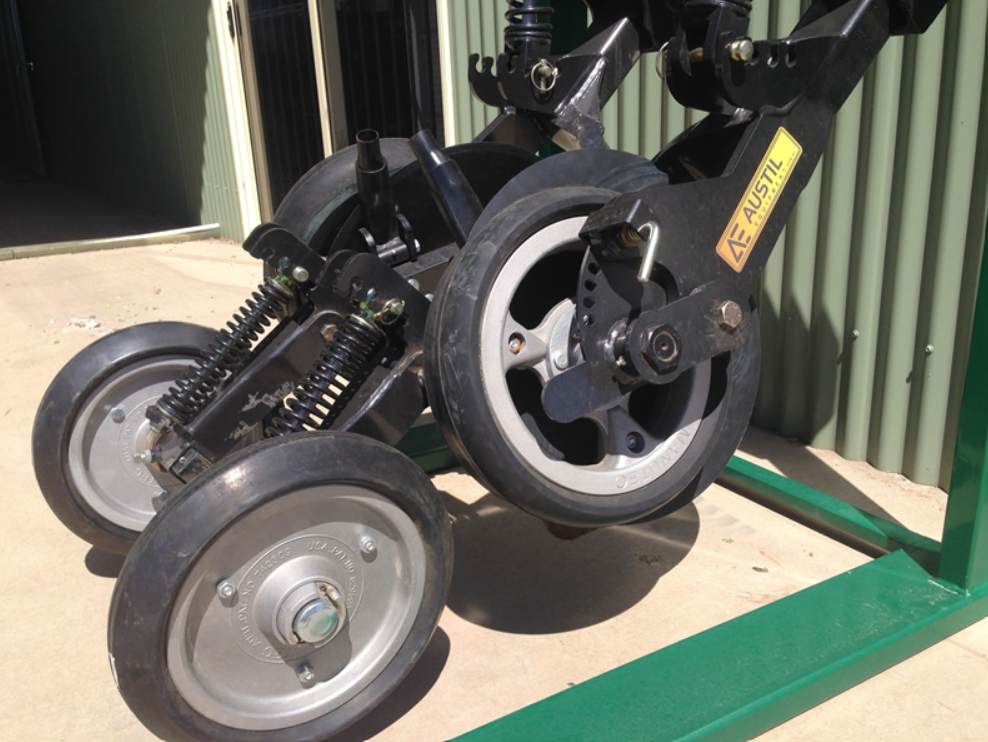
Image Credit: Austil Equipment (Simplicity Australia), website image Simplicity Australia, 2016.
Disc Seeding Opener Layout and Key Specs
Both models run a 508mm disc (6mm thick) mounted on a heavy-duty hub. Growers can adjust penetration pressure through four downforce settings, which gives flexibility across different soil types and residue loads. The review noted that replacement discs stay relatively affordable, which helps growers keep long-term running costs manageable.
A side-gauge wheel controls depth, and growers adjust it with a spring-loaded pin across six positions. During damp sowing windows, growers can fit standard mud scrapers to reduce soil build-up on the disc. Trailing press wheels—typically a Manutec-style design—pivot on a cast arm. Growers set these wheels across three pressure levels with a simple pin system.
Built Heavy for Disc Seeding, But Often Maintainance
Austil openers stand out for their substantial cast frame and high unit weight. These features improve stability and penetration in firm country. Austil also fits cast seed boots suited to larger seed, and a tungsten wear tile protects the leading edge. Growers can shift the boot position as the disc wears to keep alignment accurate. This durability comes with a trade-off in service time: operators need to grease both the disc and the depth wheel daily. Austil seals the press wheel bearings in most setups.
Indicative pricing (inc GST) as of 2016
A 12m MT3500 bar on 381mm spacing is priced around $167,000.
Operator Snapshot: Neil McVeigh, Jimbour, QLD
Neil McVeigh runs three Austil bars on 500mm spacing in a mixed program spanning winter cereals and summer crops. The crops include sorghum, mung beans, corn, chickpeas and irrigated cotton. He values the opener’s weight in dry conditions for strong penetration and fertiliser placement. Neil notes heavy corn residue can sometimes gather behind the boot. His solution was integrating scrapers into the depth wheel, which improved cleaning. Disc sets last about three years (around 12,000ha) in soft black soils. The effective depth tops out near 100mm before he switches to tines to chase deeper moisture. His key message: when moisture allows clean cutting, discs consistently beat tines on strike and establishment – provided discs stay true and round to avoid jamming.
Operator Feedback in Detail
| Operator: | Neil McVeigh |
|---|---|
| Location: | Jimbour, QLD |
| Operation size: | 6,000 ha |
| Crops: | Sorghum, mung beans, chickpeas, barley, wheat, corn, irrigated cotton |
| Annual Rainfall: | 660 mm (summer-dominant) |
| Soil types | Soft vertosols / soft black soils |
| Disc seeder Brand | Austil |
| Disc seeder model | MT3500 |
| Machine Width: | Not stated. (report notes 12 m bars most common generally; Neil’s specific bar widths not stated) |
| Seeder Weight | Not stated: On broadacre disc bars, a “standard” 12 m frame with ~24 disc units usually ends up around 9–12 tonnes |
| Row Spacings | 500mm |
| Sowing speed | Not stated but on average 10–12 km/h |
| Fuel Economy | Not stated: On avergae 2.5 to 3.5 L/ha average while sowing. |
| Target sowing depth | Effective to 100 mm; deeper moisture work with tines |
| Maintenance time | Each unit requires a daily greasing on both the depth wheel and main disc but on some machines there is a third grease nipple on the press wheel for each unit. Disc bearings are changed whenever the discs are changed – a lot easier to do in the workshop than the paddock on failure. The job would be made easier if the whole hub was replaceable than have to disassemble, re-pack and reassemble. |
| Number of seeders: | 3 seeders |
| Tractor | Not stated: For a standard 12 m disc bar in Australia, manufacturers typically spec about 240–330 hp (180–245 kW) |
| Indicative Pricing 2016 (inc gst) | $167,000 for a 12 m bar with MT3500 units on 381 mm spacing |
| Final Remarks | Neil values the Austil’s heavy build for penetration and reliable strike in dry conditions, saying discs outperform tines when moisture allows clean cutting. Corn trash can build behind the boot and cleaning needs attention, so he modified scrapers and stresses keeping discs true to avoid jams. |
Cross Slot: The High-Tech Hybrid That Thinks Like a Tine and Cuts Like a Disc
Cross Slot is one of the most distinctive zero-till seeding systems available. Developed in New Zealand, it doesn’t sit neatly in the “disc” or “tine” camp. Instead, it combines a disc cut with tine-style seed placement to create a low-disturbance seedbed focused on germination reliability. In Kondinin’s 2016 review, Cross Slot stood out as a highly engineered machine. It featured a long-travel parallelogram for ground following and electro-hydraulic control to maintain a consistent opener angle across varying terrain.
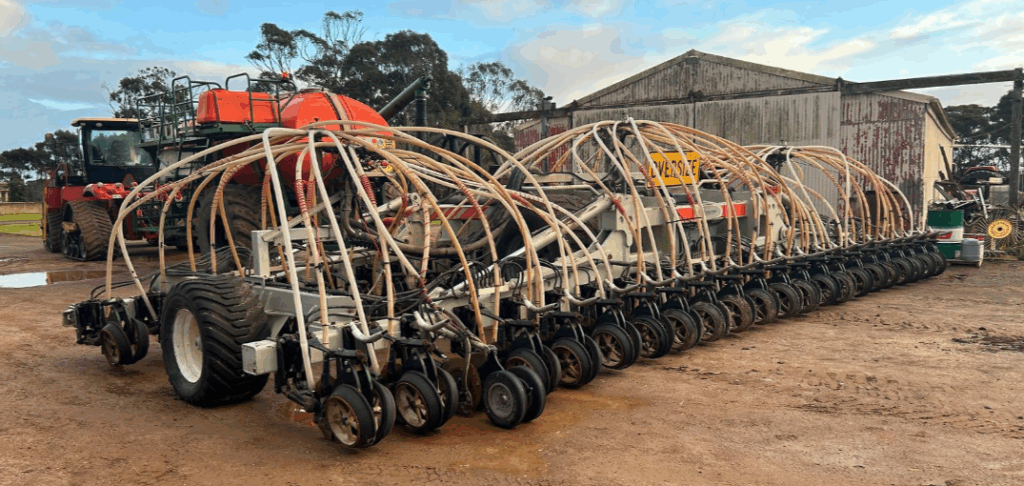
Image credit: Farm Machinery Sales (farmmachinerysales.com.au), “2017 Cross Slot” listing.
How the Disc Seeding Opener Works
ChatGPT said:
Each unit uses a single scalloped coulter to open the slot. Two split boot blades then follow—one on each side of the disc. The system places seed on one side of the slot and fertiliser on the other, which helps reduce early crop/chemical conflict. Austil fits tungsten wear protection to the key leading edges. The entire assembly weighs around 300kg per row, providing strong penetration but demanding high tractor power.
The “Winged Keel” Seedbed Concept for Disc Seeding
Cross Slot’s signature feature is its winged boot geometry. Rather than leaving a narrow vertical groove, the boots form horizontal seed shelves on either side of the cut. This creates a more sheltered, humid micro-environment. The system supports consistent closure via opposed press wheels, aiming to lift strike rates in dryland conditions without shifting much soil.
Depth Control when Disc Seeding and Packing
Load-sensing automation maintains depth. Press-wheel load cells constantly measure pressure and automatically adjust hydraulic downforce to stabilise depth across changing soil types. Operators set packing pressure manually at the rear of each unit.
Indicative pricing (inc GST) as of 2016
The 12m machine with 381mm spacing starts at $315,700, including auto-downforce control. Whilst the 18m machine on 306mm spacings is around $596,200.
Operator Snapshot: Paul Hicks, Pingrup, WA
Paul Hicks runs an 18m Cross Slot on 305mm spacing with liquid capability. His early seasons showed disc wear is the key running cost: scalloped discs lasted about 800–1000ha in his country before profile loss increased stalling risk in sandier paddocks, prompting trials of deeper scallops. Boot blades wore far slower, already exceeding 2000ha. He separates seed and fertiliser and injects liquids such as nitrogen and in-furrow fungicide through the boots. At roughly 11km/h, the bar absorbed most of a 400kW tracked tractor’s output, highlighting both the system’s capability and its power appetite.
Operator Feedback in Detail
| Operator: | Paul Hicks |
|---|---|
| Location: | Pingrup, WA |
| Operation size: | 4,500 ha |
| Crops: | Wheat, barley, oaten hay, lupins, canola |
| Annual Rainfall: | 320 mm annual; 200 mm growing season |
| Soil types | Sandy soils. |
| Disc seeder Brand | Cross Slot |
| Disc seeder model | Cross Slot (parallelogram cast-winged tine split by single scalloped disc coulter) |
| Machine Width: | 18 m |
| Seeder Weight | Cross Slot frame alone just over 22 tonnes (seeder frame weight) |
| Row Spacings | 305mm |
| Sowing speed | 11 km/h |
| Fuel Economy | 4.3 L/ha (about 85 L/hr with engine tuned; ~15% higher untuned) |
| Target sowing depth | Not stated: With a Cross Slot disc seeder around Pingrup, average target sowing depth is about 2 cm for cereals, 1.5–2 cm for canola, and 3–5 cm (around 4 cm) for lupins. |
| Maintenance time | Despite the design complexity, disc replacement is relatively simple according to owners who estimate it took around 3 hours for four men with impact wrenches to replace a set of discs. |
| Number of seeders: | 1 seeder |
| Tractor | Steinbauer-tuned John Deere 9520T tracked tractor, 400 kW (530 hp) |
| Indicative Pricing 2016 (inc gst) | 12 m @ 381 mm spacing starts $315,700; 18 m @ 306 mm spacing around $596,200 |
| Final Remarks | Paul rates Cross Slot for strong placement and emergence from seed/fertiliser separation and liquid delivery, but says disc wear is the main cost, with scallops stalling as they wear in sandier soils. Despite the high power demand, he expects to reduce seeding rates over time due to improved strike. |
Serafin Ultisow: A Straightforward Single-Disc Built for Broadacre Disc Seeding Scale
Serafin Machinery (Griffith, NSW) positions the Ultisow as its main broadacre single-disc platform. They built it for growers who want tough, uncomplicated disc seeding. The company also tailors Ultisow bars to suit wheel tracks, bar layouts, and options like liquid tanks. At the time of the review, Serafin offered Ultisow bars in working widths up to about 20m.
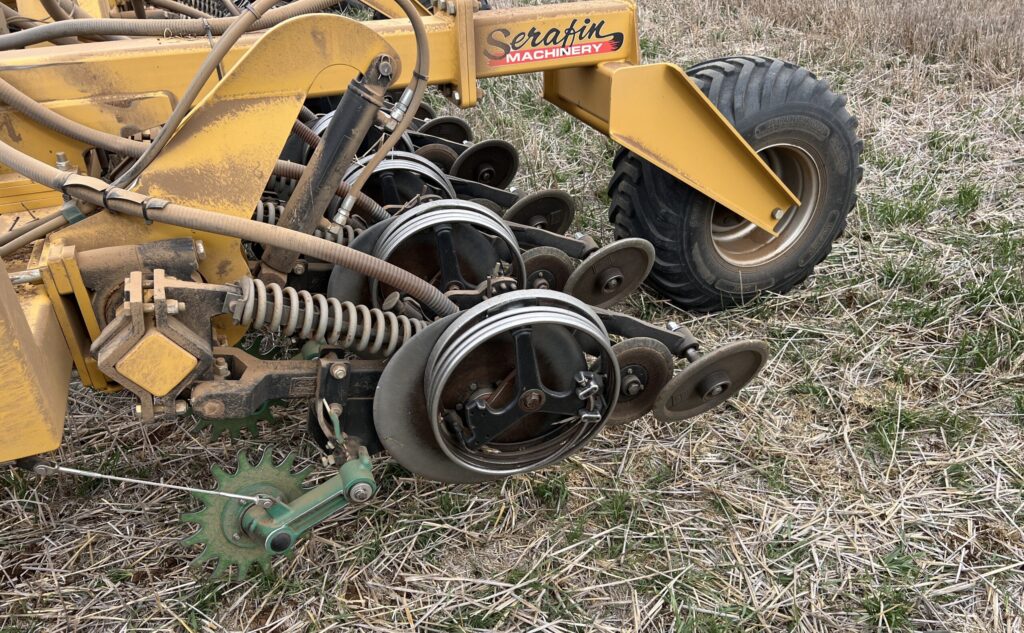
Disc Seeding Opener Design
The Ultisow uses a simple system: a 510 mm-diameter, 6 mm-thick disc. Further, it features a press wheel, and a trailing cast-iron closing wheel to seal the slot. The disc runs at roughly a 7° tilt, giving reliable cutting and slot formation without excessive draft. The closing wheel can provide some soil throw back into the seeding trench. In certain soils, some operators remove the closing wheel and rely solely on the disc and press wheel.
Depth Wheel, Weight, and Downforce
Penetration is a defining feature. Each row unit weighs around 270kg, and a large cast-iron arm carries it slightly behind the toolbar. This layout helps the opener track smoothly over changing ground. A side gauge wheel controls depth and keeps residue flowing freely. Serafin fits a standard 380mm gauge wheel with a four-spoke construction, with 115mm standard or 75mm narrow width options. A spring-loaded pull knob locks the wheel into six depth notches for quick paddock adjustment. The main frame delivers hydraulic downforce through a rolling-bar system, and operators can adjust pressure across a wide range from the cab or manually.
Disc Seeding Maintenance and Cost Notes
Servicing is straightforward: two grease points per opener on ~50-hour intervals, tapered-roller disc hubs, sealed bearings elsewhere, and an adjustable/removable scraper.
Indicative pricing (inc GST) as of 2016
Indicative 2016 pricing was about $271,000 for a 20m bar on 300mm spacing.
Operator Snapshot: John Giffin, Elmore VIC
John Giffin ran a 12m Ultisow S40 on tight 200mm spacing in clay-loam soils, largely dry sowing cereals and canola. Using RTK guidance, he targeted 25–35mm depth behind a 253kW Case IH FWA. After about 2500ha, he recorded about 25mm of disc-diameter wear. He said the machine is reliable, handles grain well, praising the simple depth/downforce controls and easy grease access. Notably, John advised keeping scraper gaps correct and watching press-wheel wear. Since the 2022 planting season, John has fitted the RYAN NT Coil Gauge and Closing Wheels to his Serafin bar.
Operator Feedback in Detail
| Operator: | John Giffin |
|---|---|
| Location: | Elmore, VIC |
| Operation size: | 1,635 ha |
| Crops: | Wheat, barley, canola, oats |
| Annual Rainfall: | 350 mm |
| Soil types | Clay-loam soils |
| Disc seeder Brand | Serafin |
| Disc seeder model | Ultisow S40 single disc |
| Machine Width: | 12 m |
| Seeder Weight | 270 kg per opener. Estimated seeder frame weight (complete 12 m bar with 60 Ultisow S40 openers): ~15.6 t (allow 15.5–16.5 t). |
| Row Spacings | 200mm |
| Sowing speed | Not stated but on average 10–12 km/h. |
| Fuel Economy | Not stated: For a 12 m Serafin Ultisow S40 single-disc system with 24 units on Elmore clay-loam, a realistic average fuel use while sowing is about 3–4 L/ha, |
| Target sowing depth | 25–35 mm |
| Maintenance time | Grease interval ~50 hours (2 nipples per opener); time not stated |
| Number of seeders: | 1 seeder |
| Tractor | 253 kW Case IH FWA |
| Indicative Pricing 2016 (inc gst) | $271,000 (20 m Ultisow single-disc machine on 300 mm spacing) |
| Final Remarks | John finds the Ultisow strong, simple, and easy to adjust, with reliable dry-sowing performance and minimal bearing trouble. His main advice is to keep scraper clearances right and monitor press-wheel wear as discs wear. |
NDF SA650: A Heavy-Duty Single Disc Built Around Disc Seeding Reliability
NDF, based in Narromine, NSW, builds large broadacre disc seeding machines and often tailors each build to the buyer. Across the range, NDF relies on the SA650 single-disc opener as the backbone platform. NDF equips the SA650 with high unit weight to deliver dependable performance in harsh zero-till conditions, where penetration, depth accuracy, and low downtime matter most.
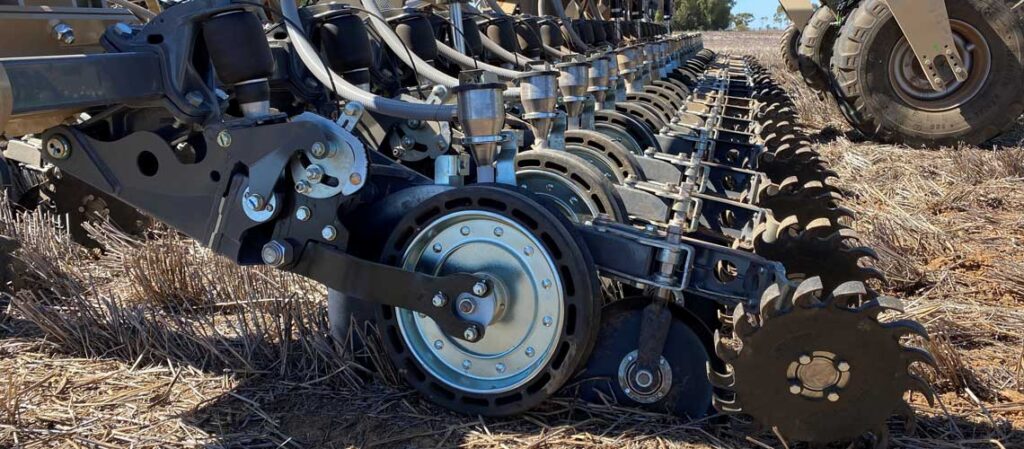
Image credit: NDF Disc Planters (ndf.com.au), SA650E product page.
Disc Seeding Opener Platform and Depth Range
The SA650 runs a 560mm single disc (6mm or 8mm thick) partnered with a 550mm gauge/depth wheel. The NDF SA650 system reviewed sits in the heavier disc seeder class. It's row units weigh 185kg per row but the shear number of them usually fitted to a 24m frame gives this system some serious weight (estimated at 21–23t). This feature gives substantial cut and reliable penetration in firm ground. Depth adjustment is a standout feature. Operators can set depth from roughly 15mm to 135mm in 5mm steps using a simple nut-and-indicator window system. Gauge wheel clearance to the disc is also easily tuned. The wheel includes an integrated concave scraper to manage mud in damp windows.
Downforce, Closing, and Herbicide Considerations when Disc Seeding
Downforce is supplied through a twin airbag system acting on the swing arm. Air pressure is supplied by a hydraulic compressor and receiver. Providing a dampened, stable response when soil firmness changes across the bar. Behind the disc, NDF offers a steel press-closer wheel for firming. Further it features an optional spider wheel that runs over the slot to increase soil movement. The spider wheel can aid residual herbicide incorporation where needed.
Low-Maintenance Bearing Design for Disc Seeding
One of NDF’s biggest practical wins is the oil-bath bearing hub. SKF double-row taper roller bearings run sealed in oil, so there are no grease nipples on the openers. Daily servicing is mainly limited to the frame. Discs are quick to swap. Typically a 2–3 minute job per unit once the press wheel is dropped. And the boot can be slid forward as discs wear to maintain alignment.
Indicative pricing (inc GST) as of 2016
The 24m model with 375mm spacing, closing wheels, and diffusers is $572,000. Whilst the 13.3m model, with the same specs as the 24m, is $308,000.
Operator Snapshot: Glenn Coughran, Beefwood, Moree NSW
Glenn Coughran runs two 24m NDF bars (333mm spacing on a double gang and 375mm on single row) over ~11,000ha of self-mulching black clays in a ~350mm rainfall zone. Mostly sowing wheat, barley, sorghum and chickpeas. He replaces discs only every two seasons (about 2700km of life), with 8mm replacements around $125 each. Boots are hard-faced pre-season, and hub bearings have had zero failures in four years. Only one failure occurred among 408 sealed bearings on closing, gauge and spider wheels. Typical sowing speed is 10–12km/h. The two machines can cover ~1000ha/day behind 436kW tracked tractors, burning about 3.7L/ha of fuel. Glenn’s main praise is reliability, and NDF’s steady refinement of the SA650. Noting only that extra under-disc clearance could help trash flow in very wet, heavy-residue situations.
Operator Feedback in Detail
| Operator: | Glenn Coughran (Farm Manager, “Beefwood”) |
|---|---|
| Location: | Moree, NSW |
| Operation size: | 11,000 ha |
| Crops: | Wheat, barley, sorghum, chickpeas |
| Annual Rainfall: | 350 mm |
| Soil types | Self-mulching black clay |
| Disc seeder Brand | NDF (Go Zero Pty Ltd.) |
| Disc seeder model | SA650 single-disc opener on NDF bars |
| Machine Width: | 24 m (two bars on farm) |
| Seeder Weight | 185kgs per opener. Estimated total machine weight: ~21–23 tonnes |
| Row Spacings | One bar 333mm (double gang frame); one bar 375 mm (single row) |
| Sowing speed | Typical 10 km/h (up to 12 km/h in good conditions; ~8 km/h when chasing moisture) |
| Fuel Economy | 3.7 L/ha (≈86 L/hr at ~70% engine load) |
| Target sowing depth | Depth adjustable 15–135 mm in 5 mm steps |
| Maintenance time | Minimal daily servicing; no grease nipples on row units (oil-bath bearings). Daily greasing only on frame/hitch; time not stated |
| Number of seeders: | 2 seeders |
| Tractor | Two Challenger MT875C tracked tractors, 436 kW (585 hp) |
| Indicative Pricing 2016 (inc gst) | 24 m, 375 mm spacing with closer wheels + diffusers: $572,000; 13.3 m same specs: $308,000 |
| Final Remarks | Glenn’s standout feedback is reliability — oil-bath hubs remove daily greasing and bearing failures have been almost nil over big hectares. Discs last well in their black clays, though wet heavy residue can still restrict trash flow. |
Tobin Bullet & Tobin Tornado: High-Speed Single-Disc Planting Built for Disc Seeding Scale
Tobin’s Bullet seeder, built in Forbes, NSW, was assessed by Kondinin as a purpose-built disc seeding machine. It's a machine for growers who need to plant large areas quickly. The review emphasised its simple, high-work-rate layout and suitability for broadacre controlled-traffic systems. The newer Tobin Tornado wasn’t field-inspected in 2016. The report describes it as a refined next step from the Bullet platform, aimed at the same high-hectare market.
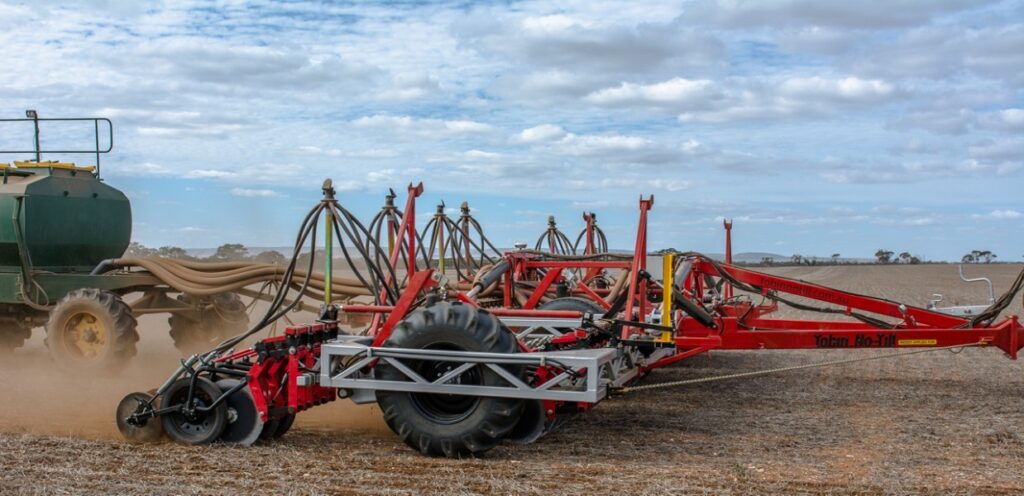
Image credit: TradeFarmMachinery, “Tobin No-Till Tornado in running for Henty Machine Award” article (2015).
Disc Seeding Opener Layout: Paired Discs for Speed and Simplicity
The Bullet uses single-disc openers arranged in pairs. Optional “muffler wheels” can be placed between pairs to reduce soil throw at high speeds. Behind the discs is a bank of four pneumatic press wheels running on shared bearings. A key feature is that the press-wheel module. The modules are separate from the disc arm, keeping the system modular and easier to maintain.
Hardware highlights include a large 610mm planting disc (6mm thick). Plus a spring-loaded blade scraper above the disc, and a tungsten-protected seeding boot. Scrapers are also used on press wheels and transport tyres to limit mud or residue build-up. Replacement costs listed in the review were roughly $105 per disc and about $77 for boots or scrapers.
Depth and Pressure Control from the Cab
Unlike many single discs that rely on gauge wheels per opener, the Bullet sets depth hydraulically at the frame level. Instead, the openers rely on machine weight for penetration. A prominent in-cab indicator displays depth and press-wheel pressure, so operators can tune settings on the go as soils change. Operators can also shift boot position through four stages to keep alignment true as discs wear.
Low Daily Maintenance for Disc Seeding Efficiency
Row units have no grease nipples. Only four grease points exist on the main frame, thanks to sealed taper-roller hubs, Tobin-backed bearings, and a three-year warranty.
Tornado Update: What Changed
The Tornado retains the 610mm discs. Notably, it moves to a more integrated dual-parallelogram row unit with depth, press wheels. Plus each opener has hydraulically controlled downforce built into it.
Indicative pricing (inc GST) as of 2016
The 12m Tobin Bullet on 305mm spacing is $209,000, and the 12m Tobin Tornado on 305mm spacing was also $209,000.
Operator Snapshot: Murray Wise, Bowenville, QLD
Murray Wise ran a 12m Bullet on 380mm spacing in controlled traffic. He sowed up to 22km/h, reported clean residue flow with no hair-pinning, and ran press wheels at around 15 psi while balancing hydraulic downforce. In soft vertosols, disc wear was minimal after ~3000ha (≈2500km). Harder red-brown clays caused some rock damage to boots/cleaners, and large seeds at extreme speed could occasionally block.
Operator Feedback in Detail
| Operator: | Murray Wise |
|---|---|
| Location: | Bowenville, QLD |
| Operation size: | 1,620 ha |
| Crops: | Sorghum, mung beans, chickpeas, wheat, canola |
| Annual Rainfall: | 635 mm (summer dominant) |
| Soil types | Red-brown rocky clay to black vertosol clays |
| Disc seeder Brand | Tobin |
| Disc seeder model | Bullet single-disc (paired units); Tornado = evolved Bullet with dual parallelogram |
| Machine Width: | 12 m (operator’s Bullet) |
| Seeder Weight | Not stated, but a 12 m Tobin Bullet build is typically in the ballpark of: 10–14 tonnes tare |
| Row Spacings | 380mm |
| Sowing speed | Up to 22 km/h |
| Fuel Economy | For a 12 m Tobin Bullet single-disc (paired units) sowing at Bowenville on red-brown rocky clays through to black vertosols, a realistic average fuel use is about 3–4.5 L/ha. |
| Target sowing depth | Not stated: On a Bowenville dryland Tobin Bullet program you’re generally targeting about 35–45 mm depth for most crops, with canola shallower at ~15–25 mm and sorghum/chickpeas deeper around ~40–60 mm (up to ~75 mm if chasing moisture). |
| Maintenance time | Minimal daily servicing; disc units have no grease nipples; only four grease points on frame (time not stated) |
| Number of seeders: | 1 seeder |
| Tractor | John Deere 8370RT (tracked) towing Bullet + 13,000 L Simplicity air cart with liquid tank |
| Controlled traffic Yes/No | Yes (controlled traffic on 3 m centres) |
| Indicative Pricing 2016 (inc gst) | 12 m Bullet @ 305 mm spacing: $209,000; 12 m Tornado @ 305 mm spacing: $209,000 |
| Final Remarks | Murray loves the Bullet’s speed and clean residue cutting, comfortably sowing at very high work rates with minimal wear in soft vertosols. Very large seed at extreme speed can occasionally block, and harder clays increase rock-damage risk. |
Morris Razr: A Disc Seeding System Built for Accuracy and Ground Following
The Morris Razr is a next-generation disc seeding platform that launched in Australia in 2012, succeeding the Never-Pin system. In Kondinin’s 2016 review, it stood out for not being a simple “disc on an arm” design. Instead, the Razr is engineered to maintain depth consistency and hold opener angle steady across uneven paddocks. A key priority for growers working large zero-till hectares.
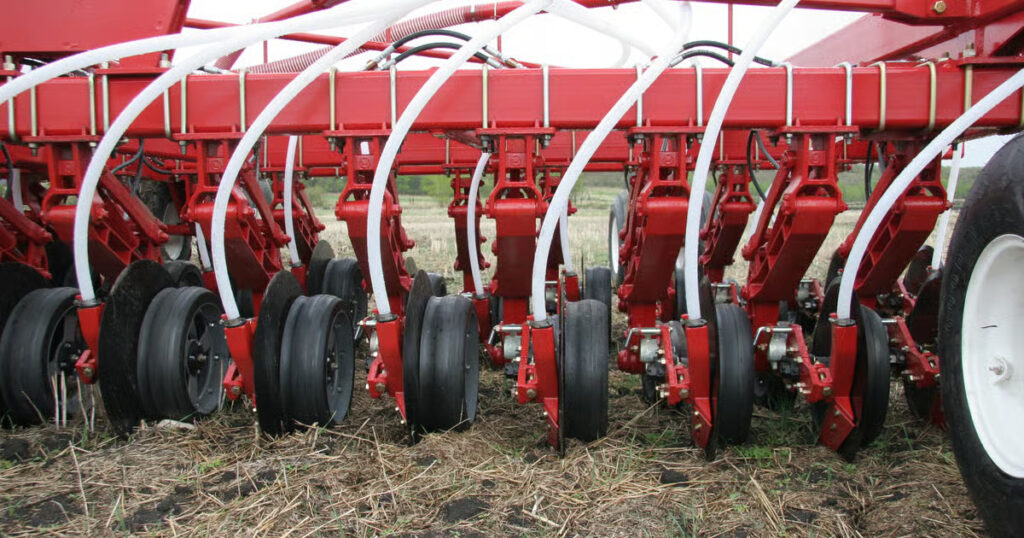
Image credit: RealAgriculture, “The Morris Razr Disc Drill Features New Opener, Simplified Design” (2013).
What Makes the Razr Different
Two structural features define the Razr row unit. First is its long-travel parallelogram linkage. This feature provides roughly 450mm of vertical movement so the opener can follow contours without changing working geometry. Downforce is applied hydraulically through a ram and accumulator. Second is a walking-beam pivot between the disc and press wheel. This balances pressure across the opener and closing system and improves ground following. Plus keeps scraper angle stable relative to the soil surface.
Disc Seeding Opener Specs and Adjustment
Each disc seeding unit uses a 500mm single disc at about a 5° attack angle, with no vertical tilt. A 405mm spoked gauge wheel runs close to the disc to control depth, and a hardened scraper ring on the wheel edge keeps disc faces clean. The seed boot also acts as an opposing disc scraper and can be adjusted forward as discs wear. Depth changes are simple (clip-pin-shift-lock), and packing pressure remains proportional to disc pressure via the walking beam, typically about one-third of disc downforce (around 30–68kg).
Downforce Range and Fit
Hydraulic downforce ranges from 90kg to 313kg per row, depending on bar weight. Standard machines were commonly 12m, 15m, or 18m frames.
Indicative pricing (inc GST) as of 2016
The 12m Morris Razr bar with 47 units on 254mm spacing costs $205,070. The 18m Morris Razr bar with 71 units on 254mm spacing costs $314,400.
Operator Snapshot: Ben Hurle, Moree NSW
Ben Hurle ran an 18m Razr (48 rows at 380mm) across four seasons in controlled traffic on hard black clays. He cropped about a quarter of his 15,000ha property with the system. Typical speed was 8–8.5km/h at ~40mm depth behind a 305kW tractor, using about 5L/ha. He rated seed placement and reliability as standout strengths, with excellent stubble flow and no hair-pinning or disc stalling. He learned a key lesson and now replaces discs annually after earlier over-wear affected depth. The updated boots wore slowly. He also found that press wheels drove most of the wear cost because the rubber isn’t replaceable.
Operator Feedback in Detail
| Operator: | Ben Hurle (Cropping manager, “Brudle Park”) |
|---|---|
| Location: | Moree, NSW |
| Operation size: | 15,000 ha cropped |
| Crops: | Barley, wheat, sorghum, chickpeas |
| Annual Rainfall: | 510 mm |
| Soil types | Hard black clay soils |
| Disc seeder Brand | Morris |
| Disc seeder model | Razr single-disc with parallelogram + walking-beam pivot |
| Machine Width: | 18 m (operator machine) |
| Seeder Weight | Not stated: A Razr 18 m single-disc bar with 47 units at 380 mm spacing will typically tare at about 17–21 tonnes. |
| Row Spacings | 380mm |
| Sowing speed | 8–8.5 km/h (10+ km/h tested but penetration dropped) |
| Fuel Economy | 5 L/ha |
| Target sowing depth | ~40 mm average depth |
| Maintenance time | Depth adjustment takes 10 minutes for entire bar; grease disc units every 3–4 days (few squirts); other points 100-hour intervals |
| Number of seeders: | 1 seeder |
| Tractor | Claas Axion 950 FWA, 305 kW |
| Controlled traffic Yes/No | Yes |
| Indicative Pricing 2016 (inc gst) | 12 m bar, 47 units @ 254 mm: $205,070; 18 m bar, 71 units @ 254 mm: $314,400 |
| Final Remarks | Ben rates the Razr’s seed placement and ground following as excellent with strong stubble flow and no hair-pinning, but discs must be replaced before over-wear affects depth. Press wheels are the main wear cost and need monitoring. |
John Deere 90 Series Openers: A Proven Single-Disc Setup for Broadacre Efficiency
John Deere has released several disc bars over time. But, the 1890 platform fitted with 90 Series single-disc openers remains one of the most widely used systems. Especially in south-eastern Australia. It’s a classic broadacre layout that prioritises reliable placement, flexible depth control, and straightforward paddock adjustment.
Opener Layout and Working Range
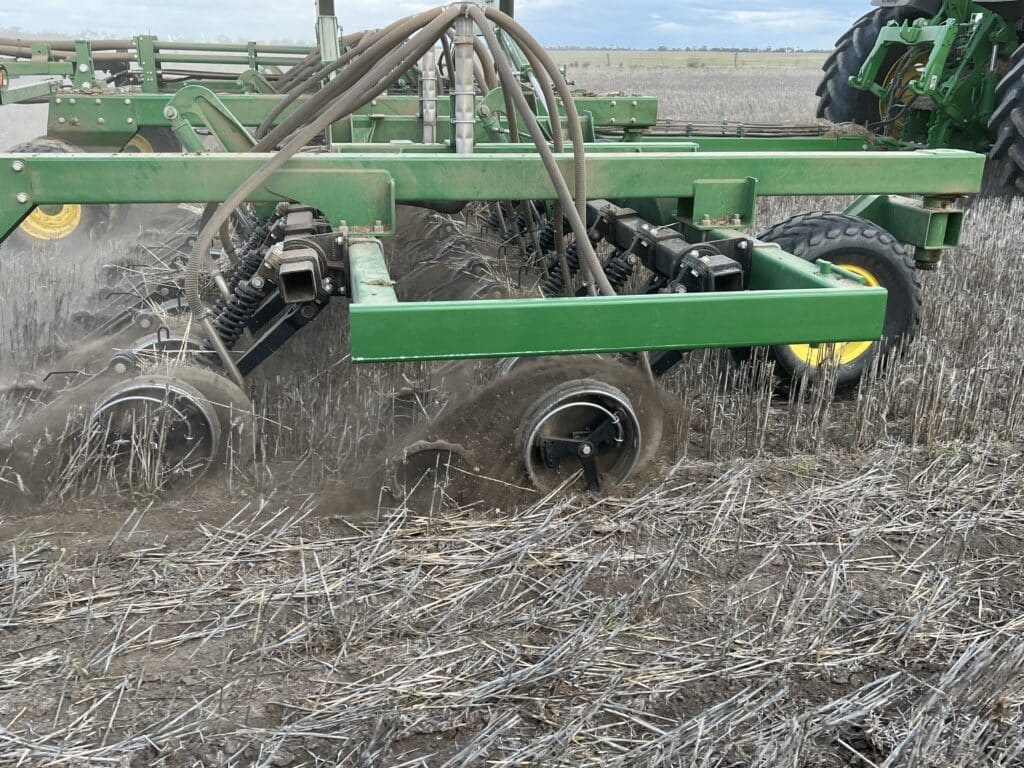
Each 90 Series unit uses a simple three-wheel seeding train. Including a single disc with a side-gauge wheel, a press wheel to firm the seed. Plus and a trailing closing wheel to seal the slot. The opener has about 50mm of free vertical travel for contour following, then continues via spring movement. With hydraulics and ballast applied, downforce typically sits in the 75–180kg per row range depending on conditions. Each opener weighs 102kg, and the 18.2m. Notably, the seeder inspected had an overall weight of 14,500kg with the openers placed at 190mm spacings.
Disc, Depth, and Ballast Features
The reviewed bars ran 460mm discs set at roughly 7° for residue slicing and mild undercutting. Depth control is a strength of this system, offering 13 positions across a working depth window of about 13–90mm in 6mm steps using a T-handle adjustment. The 405mm spoked gauge wheels flow trash well and let operators swap bearings quickly. Operators can also tune penetration by adding suitcase weights to the 1890 frame, which gives them more control in variable soils and stubble loads.
Press and Closing Wheel Adjustments
Rear wheel settings are quick and paddock-friendly. Press wheel pressure is set across three spring positions. Whilst the tension for the standard 300mm closing wheel has four settings. The closing wheels can also be moved laterally with washers to fine-tune furrow closure in different moisture or soil types.
Maintenance Expectations when Disc Seeding
Servicing is minimal: each opener has three grease points, usually handled at the start and finish of the season, unless dust requires more frequent attention. Access is easy enough to keep routine checks quick.
Indicative pricing (inc GST) as of 2016
An 18.3m frame with flotation tyres and 90-series single-disc openers at 254mm spacing is around $330,000.
Operator Snapshot: Hawkins Family, Minimay VIC
Nick and his brother Andrew Hawkins of Booroopki Farms crops just over 6,000ha and upgraded to an 18.2m 1890 for capacity. Running 90 Series units on tight 190mm rows, they sow cereals, lucerne, clover, canola and faba beans (blocking every second tube to widen beans to 380mm). Typical speed is 12–14km/h with fuel use around 2.5–4.2L/ha. They reported strong contour-following, no disc-hub bearing replacements over four seasons, and only occasional gauge-wheel bearing changes. A major plus was rapid parts support for John Deere, often arriving within 24 hours.
Operator Feedback in Detail
| Operator: | Hawkins family – Booroopki Farms (Nick & Andrew Hawkins) |
|---|---|
| Location: | Minimay, VIC |
| Operation size: | 6,070 ha |
| Crops: | Lucerne, clover, wheat, faba beans, barley, canola |
| Annual Rainfall: | 550 mm |
| Soil types | Mostly clay loams with some self-mulching clays; small pockets of sandy loam |
| Disc seeder Brand | John Deere |
| Disc seeder model | 1890 bar with 90 Series single-disc openers |
| Machine Width: | 18.2 m (operator’s machine; 1890 range 9.15–18.3 m) |
| Seeder Weight | 14,500 kg overall seeder weight; each opener ~102 kg |
| Row Spacings | 190mm standard; beans at 380 mm by blocking every second down tube |
| Sowing speed | 12–14 km/h |
| Fuel Economy | 2.5–4.2 L/ha (60–100 L/hr depending on conditions) |
| Target sowing depth | Typical 35–40 mm for most crops; beans ~55 mm; clover 13–18 mm |
| Maintenance time | Grease 3 nipples per opener at start of season and maybe once before end of sowing (time not stated) |
| Number of seeders: | 1 seeder |
| Tractor | Case IH Steiger 535 |
| Controlled traffic Yes/No | No (auto-steer used, but not controlled traffic) |
| Indicative Pricing 2016 (inc gst) | $330,000 for 18.3 m frame on flotation tyres with 90-series openers on 254 mm spacing |
| Final Remarks | The Hawkins family say the Deere is dependable, easy to set for depth across crops, and follows contours well even without strict controlled traffic. Parts support and disc-hub bearing life have been major positives, with only low-cost gauge bearings needing occasional replacement. |
Excel EI853: A Low-Cost Entry Point into Disc Seeding
Excel Agriculture’s EI853 single-disc opener has earned a reputation as one of the most budget-friendly ways for growers to transition to disc seeding. They manufacture the unit in Toowoomba, QLD, and sell it with Excel linkage or trailing-frame bars (up to around 18m). Excel also builds the EI853 to bolt onto a standard 100 × 100mm toolbar, giving farms a practical retrofit path to disc performance without buying a complete new machine.
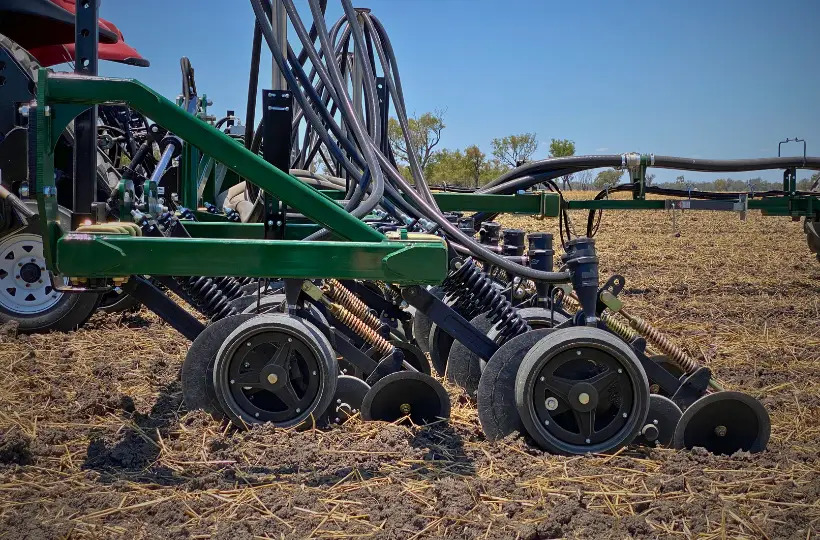
Image credit: Excel Agriculture (excelagriculture.com.au), Single Disc Row Unit page.
Opener Layout and Core Specs
The EI853 runs a complete single-disc seeding train with four rotating elements: a 457mm (18″) disc, a spoked depth/gauge wheel, a seed-firming wheel, and a trailing closing wheel. The bevelled disc operates at approximately 7°. A side-mounted boot delivers seed and doubles as a disc scraper and placement shoe, while a scraper ring on the inside edge of the 380mm gauge wheel cleans the opposite disc face. Even though the unit weighs less than many disc setups, the review praised the EI853 for its sturdy build and easy servicing, thanks to three grease points per module and generous clearance when operators raise the bar.
Downforce, Depth, and Closure Adjustments
A large coil spring on the opener pivot provides base downforce, and Excel offers hydraulics as an upgrade. Operators change depth quickly with a quadrant-style adjustment tool. Operators tune firming wheel pressure through the spring setting at the pivot, then set closing wheel pressure with a wing nut on a threaded rod through a rear spring. Excel uses cast-iron rear wheels for long wear life, and operators can shift the closing wheel sideways with washers to refine the slot finish in different moisture conditions.
Indicative pricing (inc GST) as of 2016
The 12m single fold is around $154,884. Whilst the 18m double fold: $287,375 (both trailing frame 375mm spacing).
Operator Snapshot: Randall Boughton, Moree NSW
Randall and Ben Boughton run a 12m Excel Stubble Warrior EI853 trailing bar on 333mm rows in controlled traffic near Moree. The heavier trailing frame delivers more substantial downforce than their old linkage bar. They inter-row by alternating crops; a 666mm chickpea trial was dropped after poorer yields. On black self-mulching clays, they sow at 10–11km/h behind a 324kW tracked New Holland, using about 3 L/ha. Residue flow is excellent except in heavy harvester dumps. They rate placement as very good and replace rear discs and boots as they wear (both about $60 each). In wet sowing, they wait for a dry crust to avoid mud build-up, and they’ve avoided bearing issues through regular greasing.
Operator Feedback in Detail
| Operator: | Randall Boughton (“Gilroy Farms” + leased “Allendale”) |
|---|---|
| Location: | Moree, NSW |
| Operation size: | 2,500 ha |
| Crops: | Barley, wheat, sorghum, chickpeas |
| Annual Rainfall: | 510 mm |
| Soil types | Black clay, self-mulching soils |
| Disc seeder Brand | Excel Agriculture |
| Disc seeder model | EI853 single-disc openers (Stubble Warrior trailing frame) |
| Machine Width: | 12 m trailing unit (operator’s machine; Excel bars up to 18 m) |
| Seeder Weight | Not stated: a 12 m Excel Stubble Warrior trailing bar with EI853 single-disc openers at 333 mm spacing typically tares around 10–13 tonnes. |
| Row Spacings | 333mm (operator’s spacing; trialled 666 mm for chickpeas by lifting front row) |
| Sowing speed | 10–11 km/h |
| Fuel Economy | 3 L/ha |
| Target sowing depth | Not stated: On black clay self-mulching soils, target about 25–35 mm for barley, 30–40 mm for wheat, 30–50 mm for sorghum (up to ~60 mm if chasing moisture), and 40–60 mm for chickpeas (occasionally ~70 mm if needed). |
| Maintenance time | Greased every day or two; 3 grease nipples per unit (time not stated) |
| Number of seeders: | 1 seeder (second Stubble Warrior in 12 years CTF) |
| Tractor | New Holland T8.436 FWA with rear tracks (324 kW) |
| Controlled traffic Yes/No | Yes |
| Indicative Pricing 2016 (inc gst) | 12 m single fold: $154,884; 18 m double fold: $287,375 (trailing frame, 375 mm spacing). Also notes module cost $1,815 each inc GST. |
| Final Remarks | Randall says the EI853 trailing bar delivers good placement and residue flow for the money, helped by extra trailing-frame weight for downforce. Wet sowing and wheel tracks can reduce pressure due to limited parallelogram travel, but regular greasing has kept bearings trouble-free. |
Excel SP200 Stubble Warrior: A Parallelogram Double-Disc Built for High-Hectare Zero-Till
Excel’s SP200 is the premium end of the company’s disc range — a heavier, parallelogram-mounted double-disc opener built for broadacre zero-till where depth consistency and residue flow are non-negotiable. Sold as complete Stubble Warrior machines or as standalone row units for common 150–200mm toolbars, the SP200 has been a major seller alongside Excel’s entry-level single disc, mainly because it offers stronger ground following and more precise placement when disc seeding.
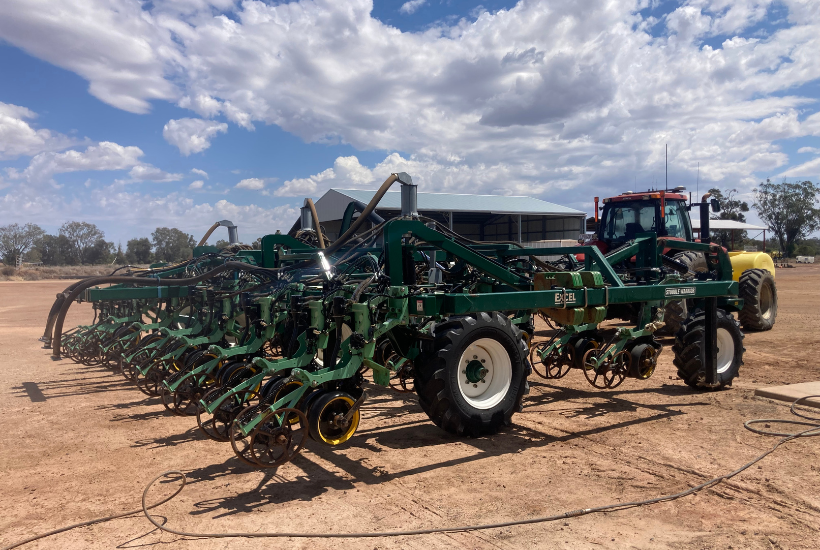
Image credit: Excel Agriculture (excelagriculture.com.au), Double Disc Row Unit SP200 product page.
Opener Design and Key Specs
The SP200 uses a symmetrical twin-disc layout: two 405mm discs (4mm thick), matched gauge wheels on either side, and large twin closing/press wheels on a pivoting rear frame. A gentle ~4° disc angle keeps soil throw low while still cleanly cutting residue. The gauge-wheel setup improves depth stability: rubber-faced wheels link together without locking rigidly, so each wheel can move slightly on its own and average depth out when one rides a track or softer patch. Optional rim scrapers and mud scrapers are available for wetter or stickier programs.
Downforce, Travel, and Serviceability
Spring downforce is applied through the parallelogram, which provides about 300mm of vertical travel for reliable contour following in controlled traffic wheelings and uneven paddocks. Like other Excel bars, the Stubble Warrior lifts high, giving excellent under-frame clearance for servicing and fast depth adjustments. A significant maintenance advantage is that opener modules have no grease nipples: sealed tapered roller bearings handle all rotating points, and stainless parallelogram pins run on polymer bushes. This keeps daily servicing focused on the frame rather than every row unit.
Indicative pricing (inc GST) as of 2016
A 12m single fold is around $206,800, and the 18m double fold is around $375,760. Whilst the 24.5m double fold is around $454,080 (all trailing frame, 375mm spacing).
Operator Snapshot: JR McDonald, Moree NSW
JR McDonald manages Ponjola near Moree, sowing ~20,000ha/year of wheat and chickpeas. He runs an 18m trailing-frame Stubble Warrior (48 rows at 375mm), typically at ~10km/h into heavy 5t/ha wheat stubble behind a 270kW tracked tractor, using just under 3L/ha in controlled traffic. He rates residue handling, seed placement, and rapid depth changes as key strengths, with only one frame crack in three years. The realities: the bar weighs ~25t, sticky mud can build on gauge wheels in wet conditions, and closing-wheel pressure needs watching when sowing deep to avoid lifting the unit. His overall message is blunt and helpful — disc seeders perform best when operators keep adjusting paddock to paddock.
Operator Feedback in Detail
| Operator: | JR McDonald (farm manager, “Ponjola”) |
|---|---|
| Location: | Moree, NSW |
| Operation size: | 20,000 ha planted per year |
| Crops: | Wheat, chickpeas |
| Annual Rainfall: | 510 mm |
| Soil types | Black clay, self-mulching soils |
| Disc seeder Brand | Excel Agriculture |
| Disc seeder model | SP200 Stubble Warrior double-disc opener (parallelogram) |
| Machine Width: | 18 m trailing-frame Stubble Warrior (operator machine) |
| Seeder Weight | 25 tonnes (unit weight) |
| Row Spacings | 375mm |
| Sowing speed | ~10 km/h into 5 t/ha wheat stubble (slightly faster in lighter residue) |
| Fuel Economy | Just under 3 L/ha |
| Target sowing depth | 50–60 mm (when inspected) |
| Maintenance time | Full annual overhaul; all discs, bearings, rubber gauge wheel tyres replaced yearly (~$30,000). Parallelogram bushes every second year. Depth change takes 2 people ~3–4 minutes. |
| Number of seeders: | 1 seeder |
| Tractor | John Deere 8360RT tracked, 270 kW |
| Controlled traffic Yes/No | Yes |
| Indicative Pricing 2016 (inc gst) | 12 m single fold $206,800; 18 m double fold $375,760; 24.5 m double fold $454,080 (all trailing frame, 375 mm spacing). SP200 opener modules $3,520 each (inc GST). |
| Final Remarks | JR credits the SP200’s build quality, depth accuracy, and residue handling for high-hectare reliability, but says weight and wet conditions can cause gauge-wheel mud lift and depth loss. Closing-wheel pressure and paddock-by-paddock tuning are critical to keep it performing. |
K-Hart Twin Disc Seeders: Simple Canadian Design with Strong Residue Flow
K-Hart seeders, built in Saskatchewan and distributed in Australia through WA dealers, were highlighted in Kondinin’s 2016 review as a practical twin-disc seeding system. The system leans on a front coulter gang to do most of the hard cutting before the seeding discs engage. It’s a straightforward approach aimed at keeping residue flow clean and draft predictable in broadacre zero-till programs.
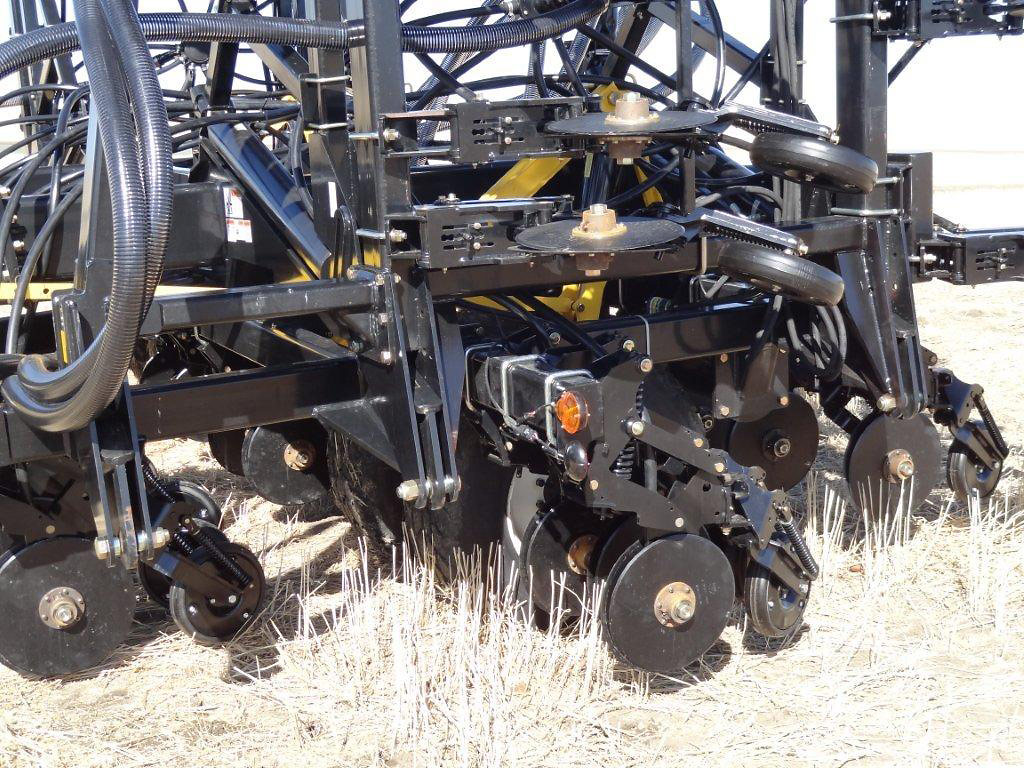
Image credit: K-Hart Industries (khartindustries.com), Model 4612 Disc Opener product page.
Opener Layout and Disc Choices
Each K-Hart row unit uses twin 406mm seeding discs with a central boot positioned between them. Ahead of the opener sits a primary coulter gang (Yetter or K-Hart), and the reviewed bar ran 508mm concave K-Hart lead coulters. While 406mm is standard, a 430mm disc option is also offered — commonly fitted in tractor wheel tracks for extra bite in compacted zones, and sometimes used across full bars where penetration is a priority.
Two Mounting Styles: 3612 vs 4612
K-Hart supplies the same twin-disc/boot arrangement on two chassis designs. The 3612 swing-arm unit is a lower-profile spring arm pivoting on a chrome shaft, with downforce of roughly 37–250kg and spring-adjustable press wheels. The 4612 parallelogram unit offers better contour tracking, with disc pressure of 50–363kg in six steps, and trailing press wheels separately sprung (9–68kg). Both disc and press-wheel pressure can be changed quickly using a T-handle system, and press wheels can be locked if required.
Wear, Bearings, and Cost Snapshot
Disc hubs use sealed double-row bearings with triple-lip seals; greasing is optional and usually required annually. Replacement costs listed in the review were about $99 for lead coulter discs, ~$70 for 430mm seeding discs, and ~$64 for 406mm discs. Indicative pricing put a 12m bar near $205k with 3612 units, or about $220k with 4612 parallelogram units.
Indicative pricing (inc GST) as of 2016
A 12m frame with 3612 openers on 381mm spacing, with K Hart opening coulters, is around $204,600.
Operator Snapshot: Courtney Foulds, Hopetoun, WA
Courtney Foulds runs a 12m K-Hart on tight 254mm spacing in southern WA, now in controlled traffic. They upgraded from 3612 to 4612 units. Courtney reported effortless residue flow through ~2.5 t/ha of wheat stubble, smooth tracking over undulations, and swift adjustments without tools. Lead coulters lasted about 2000ha (≈1670km), complete replacement took ~40 minutes with two people. The bearing sets had long lubrication intervals and Courtney suggested ~3 years per set. Typical working speed was ~13km/h, with minimal hair-pinning, only occasional pinch-jams in quartz rock. Notably, there was successful delivery of liquid fertiliser through the lead coulters. Soil throw has not been an issue and the Foulds use Trifulralin in their system. Fuel use sat around 3.5L/ha behind a 290kW tractor.
Operator Feedback in Detail
| Operator: | Courtney Foulds |
|---|---|
| Location: | Hopetoun, WA |
| Operation size: | 4,600 ha |
| Crops: | Wheat, barley, beans, canola, lupins |
| Annual Rainfall: | 450 mm (≈300 mm growing season) |
| Soil types | Sandy gravel, river loam, heavy clay |
| Disc seeder Brand | K-Hart |
| Disc seeder model | 12 m K-Hart twin-disc seeder with 4612 parallelogram twin-disc openers and 508 mm concave lead coulter gang |
| Machine Width: | 12 m |
| Seeder Weight | Not stated: a 12 m K-Hart twin-disc seeder with 4612 parallelogram twin-disc openers at 254 mm spacing and a 508 mm lead coulter gang typically tares around 14–19 tonnes. |
| Row Spacings | 254mm |
| Sowing speed | ~13 km/h in moist conditions |
| Fuel Economy | 3.5 L/ha (≈55 L/hr) |
| Target sowing depth | Not stated: For Hopetoun, WA dryland broadacre with discs, typical target sowing depths are ~20–30 mm for wheat/barley, ~10–20 mm for canola, ~40–60 mm for beans (pulses), and ~30–50 mm for lupins. |
| Maintenance time | Lubrication interval ~1000 hours; full lead-coulter disc change ~40 min with two operators (time for daily checks not stated) |
| Number of seeders: | 1 seeder (second K-Hart owned in 14 years) |
| Tractor | 290 kW Case IH Magnum 340 CVT RowTrack |
| Controlled traffic Yes/No | Yes |
| Indicative Pricing 2016 (inc gst) | 12 m with 3612 openers @ 381 mm: $204,600; 12 m with 4612 parallelogram units @ 381 mm (quick-adjust press wheels, K-Hart concave coulters): $219,890 |
| Final Remarks | Courtney reports effortless trash flow with the lead-coulter plus parallelogram setup and likes the fast, tool-free pressure adjustments. Wear life is solid, with only minor pinch-jamming in rocky soils and early large-seed flow issues fixed by enlarging seed pipes. |
Other Disc Seeding Options Worth Noting
Kondinin’s 2016 disc seeder review focused on high-volume brands, but it also documented several lower-profile machines. The machines are still relevant when comparing opener concepts and retrofit pathways. These options show a wide spread of approaches to disc layout, depth control, and downforce.
Massey Ferguson 9800 Series
The MF 9800 range was offered in broadacre widths from 9.1m to 18.2m. It uses paired 456mm discs arranged in a single gang across the frame. A significant departure from most single-disc systems is that there are no gauge wheels per row. The depth is controlled by altering the main frame height instead. Each opener receives pressure via a hydraulic cylinder, and row spacings were available in tight cereal-style configurations ranging from 150mm to 228mm.
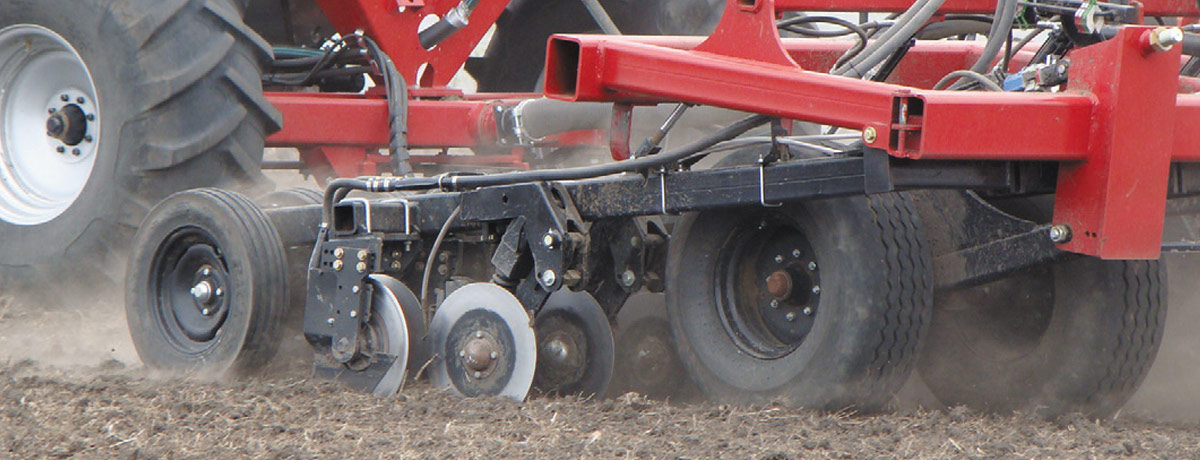
Image credit: H. Rushton & Co (hrushtonco.com.au), Massey Ferguson MF 9800 product page.
Daybreak (Milne Industries)
Daybreak openers have been used for many years, though production slowed by the time of the review. The inspected machine was a 12m 3-point linkage bar. It also has a folding system that hides rams inside large RHS main sections, keeping the transport profile compact. Units sat on 375mm spacing, but every second opener can be lifted out, doubling spacing to 750mm when needed. Openers are mounted on parallelograms and use hydraulic downforce for penetration.
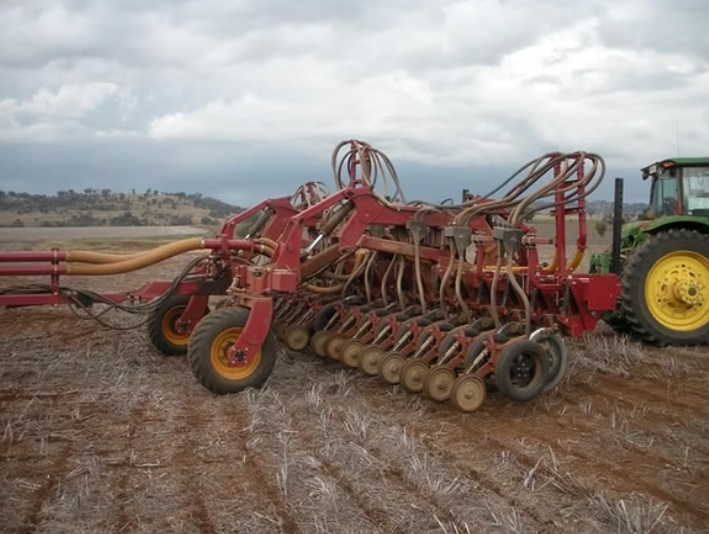
Image credit: Daybreak Equipment, Disc Openers product page, Daybreak Equipment (2022).
RFM Guidance CT Planter
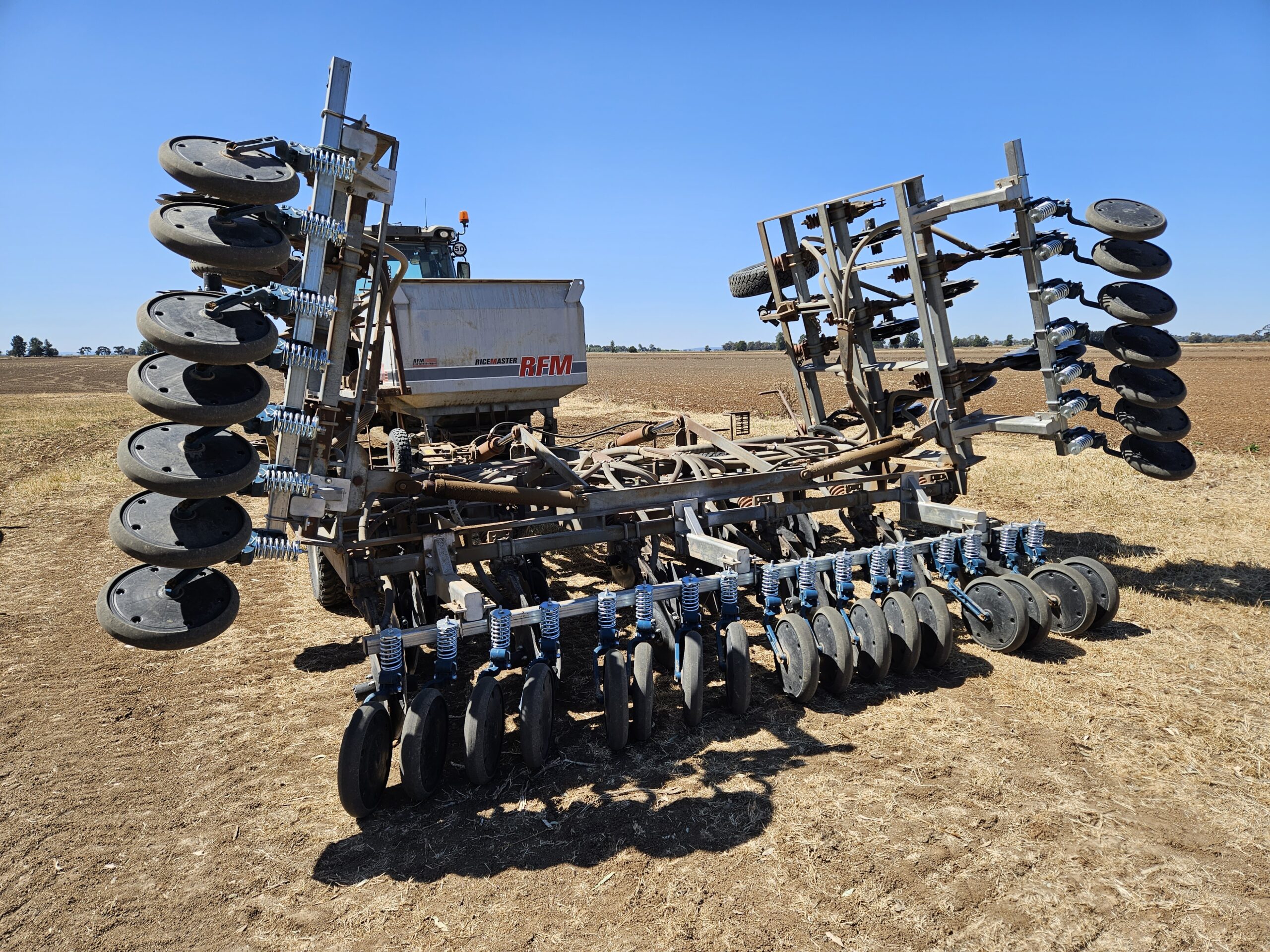
Ryan Farm Machinery’s Guidance CT Planter (Horsham, VIC) can be configured with discs or tines. The frame is built from 100 × 75 × 6mm RHS, offered in 9–15m widths with six spacing choices from 178mm to 380mm. Their double-disc setup runs at about 15°, with a serrated leading disc set 25mm ahead of the trailing plain disc. Discs are available in 380mm or 460mm diameters, and buyers can opt for two plain discs instead of a serrated + plain pair.
Gessner GSD 500 and Twin Disc Units
Gessner supplies both the GSD 500 single-disc opener and a parallelogram twin-disc opener, available as standalone units for existing bars. The GSD 500 fits 100mm and 178mm square toolbars, runs a 500mm disc, a semi-pneumatic press wheel. The system uses spring downforce delivering roughly 120–280kg of penetration pressure. The twin-disc parallelogram unit uses 457mm twin coulters, fits the same bar sizes, and is sold on rigid or floating bars from 8m to 24m.
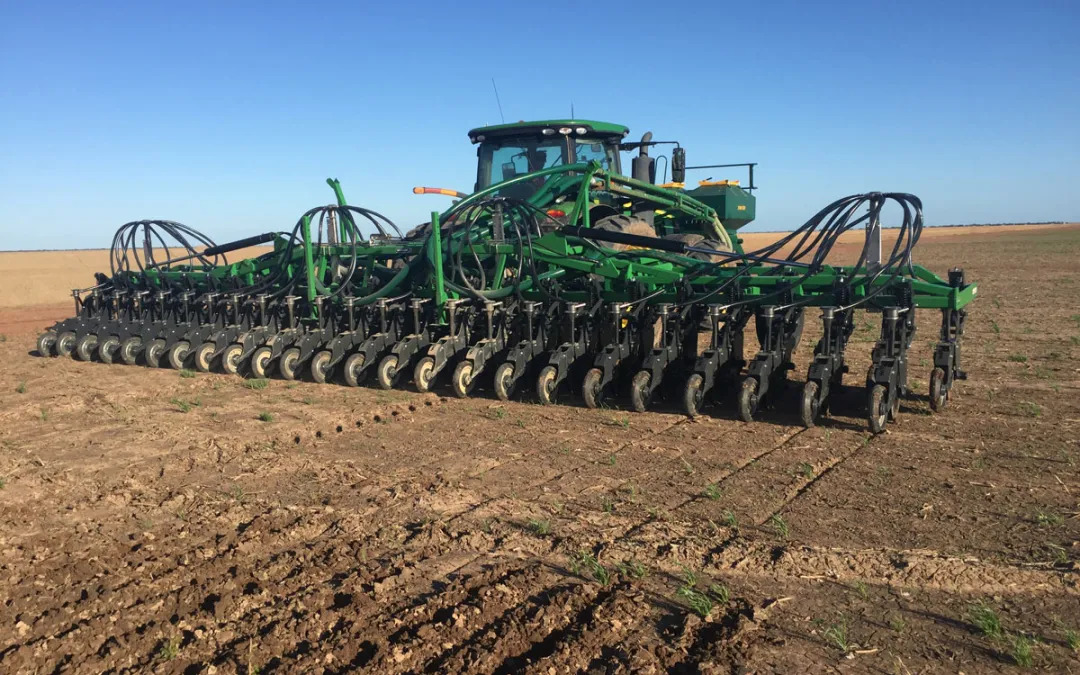
Image credit: Gessner Industries (gessner.com.au), Parallelogram Twin Disc Planter product page.
John Shearer Parallelogram Double Disc
John Shearer’s system is a simple parallelogram double-disc opener with spring or optional hydraulic downforce. It runs twin 380mm discs (plain or plain + scalloped) followed by a 380mm press wheel. The parallelogram provides about 250mm of vertical travel, and each unit weighs around 180kg.
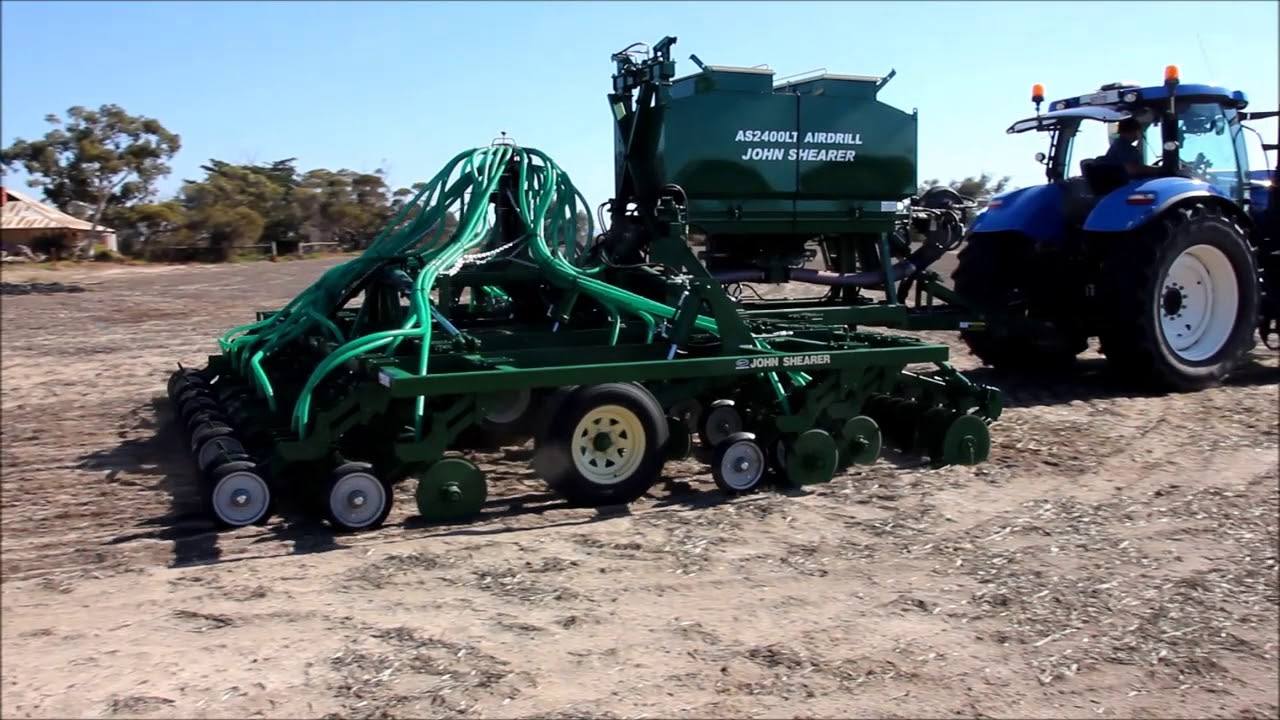
Image credit: John Shearer Pty Ltd (johnshearer.com.au), Double Disc Opener product page.
Conclusion: Big-Brands Bring Disc Performance, But Make Sure To Consider Other Practical Options
Kondinin’s 2016 review makes one thing clear: modern disc seeders can deliver excellent zero-till results. The top-end machines and opener systems are a serious capital investment. Even in 2016 pricing, full disc bars regularly sat in the hundreds of thousands of dollars. Ongoing wear costs (discs, boots, wheels, bearings) are part of the deal. For many growers, that upfront jump is the main thing holding them back from going to discs. Even when the agronomic upside is obvious.
That’s exactly where RYAN NT retrofit double discs come in. Our system is built to let you convert your existing tine bar into a disc seeder at a fraction of the cost of buying a purpose-built disc machine. Whilst still gaining the core disc advantages: cleaner stubble cutting, less hair-pinning, better early/dry sowing ability, and faster work rates with lower fuel use. The offset double-disc geometry avoids the “wedge effect” of some conventional layouts, improving penetration and reducing draft. Our front-boot and scraper design is aimed specifically at stopping blockages in both dry and damp conditions.
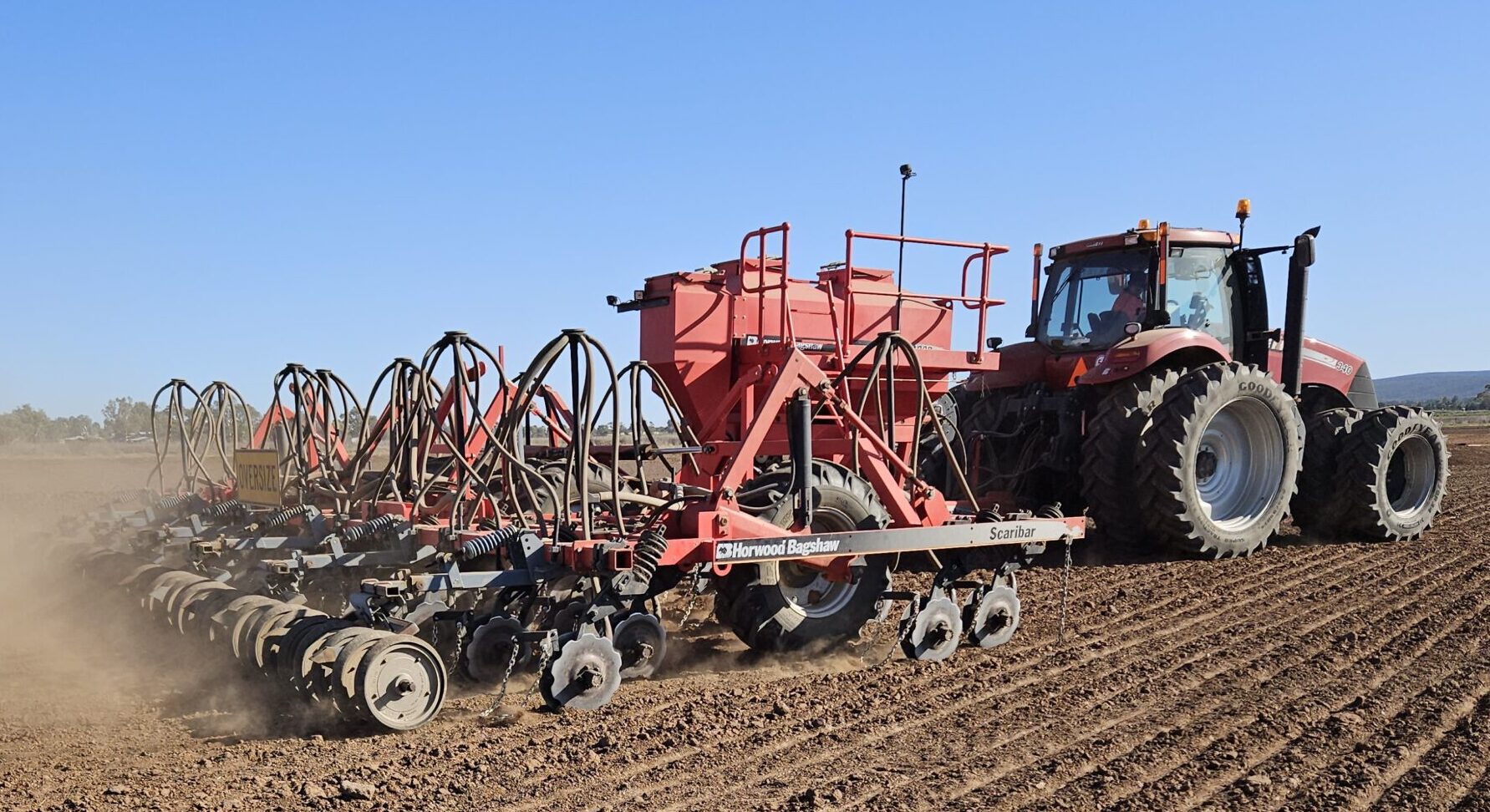
We Have It All Covered for Growers into Disc Seeding
Importantly, if you’re already running a disc seeding bar, RYAN NT upgrade components like coil gauge wheels and closing wheels. These wheels can help extend wear life and keep depth and furrow closure consistent. Especially when rubber wheels start wearing fast or packing with mud.
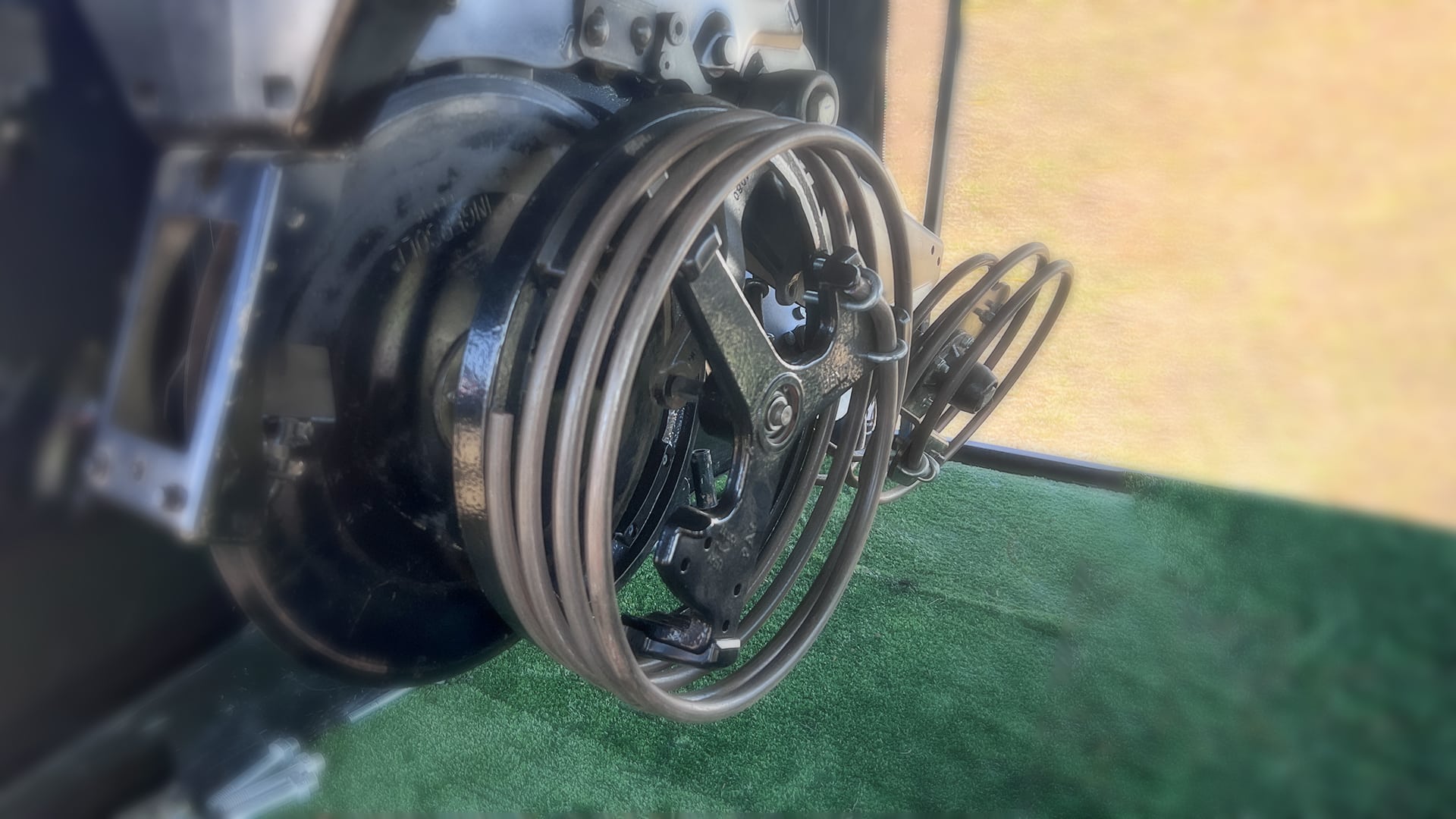
There are practical paths forward if you’re looking for a low-cost entry into disc seeding, or to sharpen the performance of your current disc system. These path don’t require replacing your whole seeder. Reach out if you want to talk retrofit fit-ups or brand compatibility. We’re happy to help you map the best next step for your bar.
Source Note: This blog is based on the independent findings in Kondinin Group’s Research Report: Disc Seeders (June 2016). The original full report is available via Farming Ahead here: https://www.farmingahead.com.au/edition/1000605/research-report-disc-seeders-doing-the-rounds-june-2016